DSSO concert notes for the works of Sibelius and Shostokovich
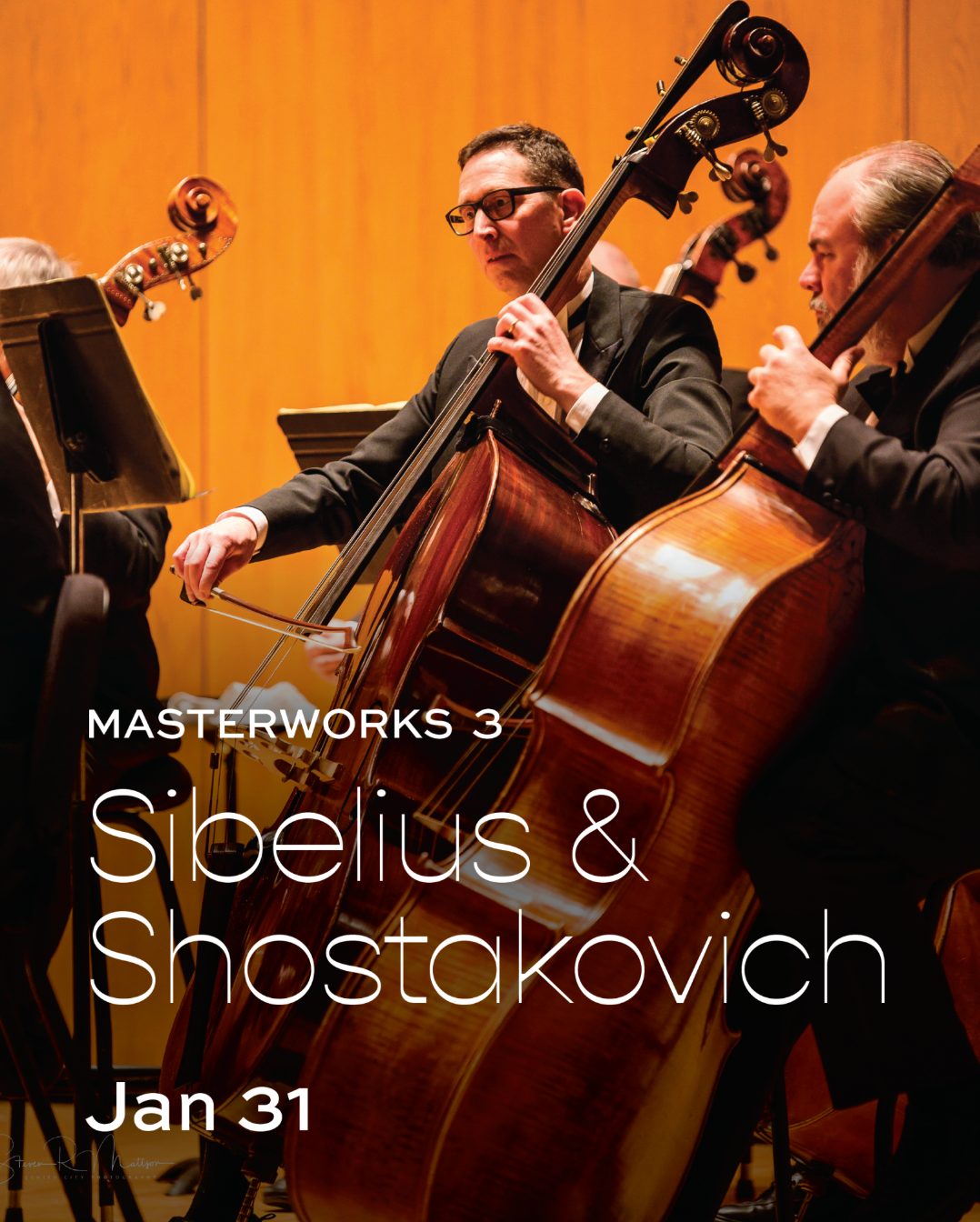
Good evening! My name is JP Gresh and it’s a pleasure to be here for the Duluth Superior Symphony Orchestra’s presentation of Sibelius and Shostakovich. I am here on behalf of Duluth Sister Cities International, a local civic group dedicated to fostering education, purpose driven foreign exchanges, and person to person diplomacy.
I am a newcomer to Duluth. I recently retired from the Army aHer several decades of service to our country, serving both in the U.S. and abroad. For the last 18 years of my service, I was an Army foreign area officer, with a specialization in Eastern Europe, Russia, and Eurasia. I helped our nation’s leadership understand the impact of U.S. actions in these places; how other nations and their militaries thought about their security and the ways we could cooperate to achieve common goals. Drawn to Duluth for its nature, grit, and winter weather, I was looking for ways to contribute to the local community. Duluth Sister Cities seemed like a natural fit.
The DSSO’s presentation of works by Sibelius and Shostakovich offers a great opportunity to showcase the importance of artistic freedom amidst turbulent times. While these composers were not close in age – nor did they ever meet, from as far as we know – they both composed at a time of great upheaval in their own countries. For Sibelius - a Finnish national awakening and eventual independence from Russia, and for Shostakovich – the formation of the Soviet State and subsequent repression under Stalin. Sibelius’ works are now highly associated with Finnish independence, and his ‘Karelian suite’ takes its name from a region currently split between present day Finland and the Russian Federation, a result of the Winter War between those countries in 1939-40. Shostakovich was the 20th century’s most prolific composer.
Jean Sibelius was born in 1869 in then the Russian-controlled Grand Duchy of Finland. ‘Finland’ was then a nationality, but not an independent country. Finland wouldn’t become a country until 1917, when it wrestled itself away from Russian rule during the Bolshevik revolution. Jean Sibelius originally trained to become a violinist but was directed towards composition after attending the then Helsinki music institute in the 1880s. Sibelius was inspired by Anton Bruckner, as well as Beethoven and Wagner, but over the years came to represent a unique Finnish type of composition, largely due to his rise in fame being coincident with the rise of Finnish identity. Nationalism was sweeping the European continent, eventually fueling the start of World War I and the Russian revolution, leading to Finnish independence as well as the death of several empires. Over time, Sibelius would draw inspiration from his natural surroundings and the developing Finnish language movement, especially the Kalevala, the first epic collection of poems published in the Finnish language in 1835. Today, many of Sibelius’ works are synonymous with Finnish identity and nationality. It shows us how artists, no matter of what time period, are able meet the moment – either politically or socially – and they can only do this when given the freedom to do so. Towards the end of his composing career in the 1930s, he listed Dmitriy Shostakovich as a then young rising composer that he respected.
Dmitriy Shostakovich was born in 1906 in St. Petersburg, then only miles away from the border with the Grand Duchy of Finland within the Russian Empire. Originally of Polish descent, his family was a typical reflection of the intermingling of ethnicity in the Russian Empire. In 1936 he came under the scrutiny of Joseph Stalin, then the general secretary of the Communist Party and most powerful man in the Soviet Union. Early in his career, he wrote musical scores for films, during a period when there was greater tolerance for avant-guard pieces and works. But over time, and as Stalin took power, more traditional and ‘patriotic’ pieces were favored among the Soviet elite. Much like the pressure on visual artists to complete works focused on ‘social realism,’ composers like Shostakovich were pressured to compose works along expressionist lines, to evoke patriotism and love of the Soviet project. Shostakovich, with the help of a network of like-minded intelligentsia and embattled artists, rode the wave of repressions throughout Stalin’s tenure. His stock greatly went up with his 7th symphony – performed first in Leningrad while it was still under siege in 1942. And having grown up in St. Petersburg, Shostakovich corresponded with followers and composers in Petrozavodsk - only 250 miles away. His works have been repeatedly performed by the conservatory there.
So why am I here?I Simply put, to help us remember that music connects people across cultural, political, and spiritual divides. Like written and visual arts, music can transport us to another world, to momentarily let us separate from the issues of the real world into another, evoking wonder, fear, compassion, tranquility, and excitement. And since we are showcasing an artist from one of our sister countries, we felt it appropriate to remind folks of our mission.
Duluth Sister Cities is here to create a space for unfettered dialogue and human to human international connections while serving the greater Duluth community. We seek to promote respect, tolerance, humility, and curiosity – values that all Minnesotans can embrace, especially during recent tumultuous events happening in our state. We have four established relationships with Petrozavodsk, Russia (1987), Växjö, Sweden (1987), Ohara-Isumi, Japan (1989), and Ranya, Iraqi-Kurdistan (2014).
With Petrozavodsk, our relationship is quite limited but seek to keep these doors ajar as long as we can preserve dialogue. We do not preserve this relationship out of respect for Russia and its government, but for the dialogue we can promote through our cooperation. Like all our city relationships, we will continue to maintain it as long as there is a willing partner, a mutual benefit, and in alignment with American values. Neither our government nor the Russian government gets a veto over our relationships and community.
We acknowledge the difficulty in working with Russians at the moment. The Russian government continues to prosecute its war against Ukraine – which will reach its fourth year in just over three weeks. To put this in perspective, Russia has been attacking Ukraine longer than it was at war with Nazi Germany from 1941 to 1945 – and with much less success, I might add,due to the resilience and strength of the Ukrainian people. Russia has abducted over 20,000 Ukrainian children and launched over 12,000 missiles and drones against that country. This winter, due to energy blackouts caused by these attacks, several hundred thousand people have left Kyiv. My Ukrainian teacher texted me just the other day attesting to the dire humanitarian situation in that city. The war is not good for Russians either. At least 200,000 Russian soldiers have been killed during the war, with some estimates up to 325,000. The Russian Central Bank maintains a benchmark interest rate of 16%, and around one third of the Russian budget goes towards supporting the war. Around 800,000 Russians have left Russia since the beginning of its war against Ukraine, the highest exodus since the 1917 revolution.
So, while we have huge differences over its war in Ukraine, we try to find common ground. I’ve lived in Russia as recently as three years ago, and I can tell you that Russians by and large are not enthusiastic supporters of their war. While we have no official city to city relationship, our current project is focused on delivering a Duluth created model of combatting domestic violence to our civil society partners in Petrozavodsk. Duluth Abuse Intervention Programs is working with Russian civil society organizations in Petrozavodsk and other towns to introduce novel ways to curb domestic and partner abuse, amid the loosening of Russia's laws around domestic violence.
I’m proud of being a part of this organization to help our community and raise awareness of how global connections impact all of us, from widening perspectives, to sharing best practices between communities thousands of miles away from each other. Gathering around art helps lower the tensions, provoke curiosity, and take solace when events around us can be quite turbulent. Marina Davydova, a Russia theater critic and producer in exile in Germany recently said that “when there is no freedom, theater begins to play a fundamental role.” In Russia, she added, the theater often becomes a form of therapy. I think the same can be said for music. Thank you to the DSSO, especially Mark Danielson, its secretary, for the warm cooperation, and to our Duluth Sister Cities Executive Director, Christy Rounds, for the initiative in setting this up.